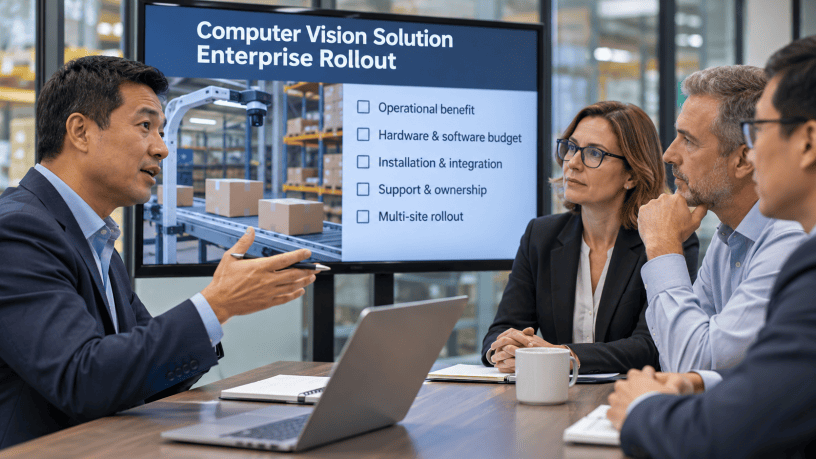
It’s a product pilot at a packing station where a camera captures the items going into a carton. Software compares what the computer vision model detects with the order record. If something looks wrong, the operator gets an alert and can check the pack.
The pilot works well enough for the warehouse manager to ask for 50 installations.
That sounds like a rather good sales conversation. But I would still be careful about forecasting the full order.
The price for this solution is $5,000 per station, with $3,000 for hardware and $2,000 for software. At the same price, 50 stations would make a $250,000 purchase.
Without understanding how the customer plans to buy, install and support the rollout post a successful pilot, I will be careful of adding this deal to the sales forecast
I’d want to understand how the customer plans to buy, install and support the rollout.
The model is only part of what the warehouse is buying
At one packing bench, the team can adjust camera placement and lighting. There may be a small set of products to check, and an operator who knows what the warning means.
Move to the next bench and the conditions might change. Similar-looking SKUs, an item covered by another item, or a different packing sequence can affect what the camera sees. If multiple OMS or WMS is used then Order data has to reach the application using a different API than the one used in the pilot.
I would be more interested in how the whole process behaves during a busy shift than in a demonstration where somebody has arranged the items neatly for the camera.
False alarms take time to investigate. Missed mismatches may end up in shipped cartons. The pilot should give us evidence of both, along with how much effort operators spend handling the alerts.
There’s another question about the alert itself. Does it tell the packer which item seems missing, or does it simply indicate an error? If every warning requires a supervisor, the warehouse might end up moving manual checking from one place to another. I’d want that tested before promising the same result at 50 stations.
Running inference on an Edge AI processor can reduce the need to send every image to the cloud. The warehouse still has physical devices and software to maintain.
If the camera at station 37 stops working, who replaces it and checks that order verification is working again? The rollout plan needs an answer beyond calling the engineer who installed the pilot.
One solution, two lines of spending
Fifty installations mean $150,000 in hardware and $100,000 in software. The customer may see one solution but have separate people approving those expenses.
The packing manager may own the problem of incorrect orders. IT may be responsible for connecting and maintaining the devices. Procurement may want to review the supplier and warranty terms. Finance may ask whether the reduction in checking effort, mistakes or rework justifies $250,000.
The same enterprise might have one central budget for this, or ask each site to fund its share. We need to find out which arrangement applies.
And before anybody asks for a savings figure, we need to know what the pilot has actually measured. An impressive alert on a screen is useful. The customer will have to decide whether the improvement is worth buying across the operation.
Who will own the other 49 stations?
I would want four matters settled while discussing the rollout:
- Evidence of an operational benefit the customer has agreed to measure.
- A decision-maker who can approve the hardware and software spending, or a clear path through both budgets.
- Agreement between operations and IT on installation, order-system integration and support.
- A plan for getting the remaining stations installed without turning every camera adjustment into a fresh engineering project.
The buyer might settle these in one meeting, or the decisions may sit with different teams. Either way, I’d want to know who owns the rollout before putting a purchase date in the forecast.
I’d want to spend time on model accuracy and how operators use the alerts. Once the buyer wants 50 stations, device failures, software changes and support ownership deserve the same attention.
If we have a working pilot but no owner for those decisions, I would be reluctant to add the $250,000 order to the forecast. I will ask “What is our plan for the other 49 stations?”
Discover more from All my Earthly thoughts
Subscribe to get the latest posts sent to your email.

