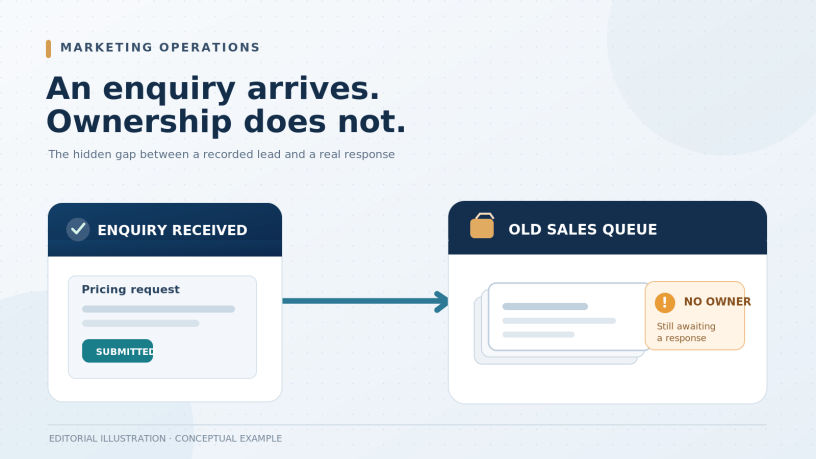
Consider a purchasing manager asking for pricing through a company website. The form accepts the request, a record appears in the CRM, and Marketing counts another enquiry. Days later, nobody has called.
The record landed in a queue still assigned to the old sales territory. The territory plan changed, but the routing rule did not. Marketing can show that the enquiry arrived. Sales can show that nobody on its current list owns it. Neither answer helps the person waiting for a reply.
That’s an awkward discovery for a new Head of Marketing. You could buy more traffic and send more people to the same unattended queue. I’d rather find out what happened to the enquiry already sitting there.
Follow the record past the form
A campaign report tells us what came in. To understand what happened next, I’d compare a few enquiries that were accepted, a few rejected and a few with no recorded action. I’d put the following records side by side.
- When the enquiry was submitted and created in the CRM.
- Which person or queue received it, including any reassignment.
- Whether someone attempted a response, and when.
- What reason was recorded for closing or rejecting it.
A completed task does not prove that a customer conversation took place. Nor does an empty activity record prove that nobody tried. You need to know what the system actually records, and ask the people responsible. Use only customer information the company is entitled to review.
One unanswered enquiry would not persuade me that the entire process is failing. The buyer may have supplied the wrong contact details or contacted the company for support. But if suitable enquiries keep appearing in the same unattended queue, the explanation deserves a closer look.
Agree on what a rejected enquiry means
A pricing request can look promising in the Marketing report. Sales may reject it because the account sits outside its target segment. Those are different judgments. Before treating the enquiry as lost or unqualified, I’d want to know who reviewed it and why.
I’d ask Sales to open a few disputed records with Marketing. Was the account already assigned to someone else? Was the enquiry outside the region served? Did it request something the company does not sell? Calling all three a ‘bad lead’ makes it rather difficult to know what needs changing.
For each disputed record, I’d keep a brief note with four parts:
- The customer’s request, in the customer’s own terms.
- The team’s stated reason for accepting or rejecting it.
- The evidence that would confirm or challenge that reason.
- The named person who can make the next decision.
The note should expose disagreements, not give everyone another form to fill out. Perhaps Marketing promised something the company cannot deliver. Perhaps Sales rejected a suitable account without speaking to it. Either way, there’s a question to settle before we argue about the next campaign.
Someone has to own the exception
CRMs assign leads to users or queues. They also do automated record-owner assignment, including cases where there is no eligible person to receive a record. But they don’t decide who should notice when a territory or team changes.
Consider the handover after a sales reorganisation. Someone approves new territories. Someone else updates CRM settings. Marketing keeps running campaigns aimed at the same customers. Who checks the first incoming enquiries after the change? And who can redirect an account when its assigned owner is no longer available?
I’d want one person accountable for reviewing unassigned or rejected records, a clear route for escalating those left untouched, and an owner for changing the assignment rule. In a small company, that may be one person. The point is to know who can act, not to create three new job titles.
The familiar call for ‘better alignment’ can wait. If the exception queue remains unattended, another meeting about collaboration has achieved very little.
Test the handover before asking for more budget
Start with one suspected routing error. Correct it for an agreed set of new enquiries, then check who receives each one, whether a response is attempted and what happens when the assigned person is unavailable. Check the exceptions as carefully as the successful cases.
If those enquiries now reach someone who can respond, the assignment change may have helped. That does not mean revenue will rise. The contacts could still be unsuitable, the offer may miss their needs, or the conversations might go nowhere. We should not call a routing test a sales forecast.
Maybe the eventual answer is a different CRM setup, more sales capacity or a better-targeted campaign. Fine. I’d still ask which failure the expense removes and what evidence could show that the change helped.
Take a different report to leadership
The usual slide says Marketing generated more enquiries while the pipeline failed to keep up. I’d rather see how many of those enquiries had an accountable owner, how many were rejected with a reason, and how many went unanswered. Then we can discuss whether this is an acquisition problem or a handover problem.
A useful update might be: ‘We found pricing enquiries routed to a queue that no longer has the right sales owner. We’re checking the affected records, correcting the assignment rule for new enquiries and monitoring the exceptions before increasing campaign spend.’ That’s a proposed course of action, not a claim that the revenue problem is solved.
If the correction makes no difference, the team has learned something and can test another explanation. If it works, the next question is whether qualified enquiries are reaching the right people and receiving useful responses.
A Head of Marketing cannot run every sales process. But when you’re asked to generate demand, it’s reasonable to ask who gets the enquiry once Marketing has done its part. Otherwise another campaign can fill a queue nobody thought to open.
Discover more from All my Earthly thoughts
Subscribe to get the latest posts sent to your email.

