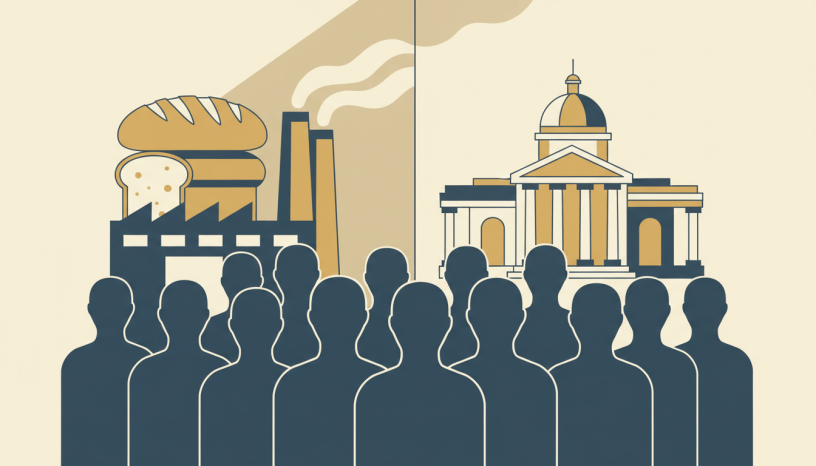
“No revolution has ever happened on a full stomach.”
It’s a striking line. But does it really explain why people protest?
When Economic Pressure Becomes Political
Consider the French Revolution. Poor harvests and rising bread prices made life harder before 1789. But France also faced a fiscal crisis and long-running disputes over privilege, taxation and political representation. Food prices mattered. So did political power.
The Soviet Union’s breakup in 1991 also involved an economy under pressure. Yet economic weakness alone does not explain its collapse. Gorbachev’s reforms, changing political authority, and independence movements within Soviet republics were part of the story.
The Arab Spring offers another comparison. Youth unemployment and the cost of living mattered. Corruption, repression and demands for political change mattered too. The mix varied across countries.
Economic insecurity appears in all three cases. It was not the only cause.
Why Do People Take to the Streets?
That brings me to the question at the heart of the original essay. Why do we protest?
If you are worried about work, food or housing, political decisions can feel personal. Economic uncertainty may add to frustration. But we cannot assume that everyone in a protest is there for the same reason.
One person may be concerned about employment. Another may be challenging unfair treatment. Others may be calling for political representation or freedom of expression. These motives may overlap, and the evidence will vary with the event and the people involved.
Consider students entering the workforce. Uncertain job prospects can shape their concerns. But it would be a mistake to treat every student protest as a reaction to employment alone. We need to consider the issues participants actually raise.
What Are We Really Protesting?
Two questions can help make sense of public demonstrations:
- What immediate issue brought participants together?
- What wider economic, social and political conditions shaped that event?
The first concerns the stated demand. The second concerns its context. Both are relevant to understanding the event.
Economic difficulty can be part of the context without explaining every person’s motives. It does not make concerns about rights or justice any less important.
Perhaps the more useful question is not whether a demonstration is about a specific issue or the economy. It is how those issues connect.
Discover more from All my Earthly thoughts
Subscribe to get the latest posts sent to your email.

