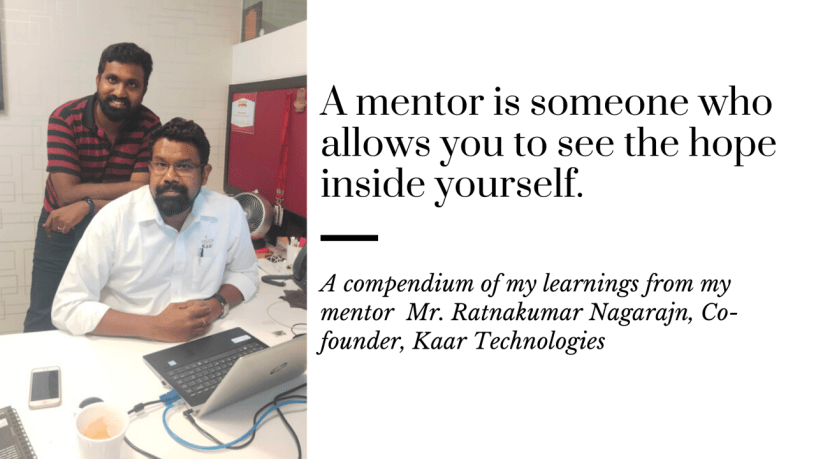
It is said that a single mentor can change your life. For most of us, our story of growth and hope begins with a single human being telling us they believe in us. Although the above statement may be shallow, you could argue that a human being’s growth just depends on him. Well yeah, that is true. But there is nothing better than a human being who trusts you and gives you confidence in yourself to help you grow.
I have written a lot about mentors. I truly believe one of the first tasks a person should do as they finish college and enter the corporate world is to find a mentor. I was lucky. I found a mentor who was also my boss. I hit the jackpot, so to speak.
A caveat here. I am writing this article not only to share my learnings but also for myself. I am writing this article to make sure that I never forget what Mr. Ratnakumar Nagarajan has taught me over the last five years and that I hold myself to the same standard he held me throughout the time I have been his pupil.
It all started around May 2015. I was part of the first batch of B-School campus recruits to Kaar Technologies. Being the first batch of Management trainees, we were treated special. Also, it was extra special for me because this was my first job as well.
Fast forward five years later, what should have been a normal career path wherein, at 28, I should have been sitting with a couple of friends. Instead, cribbing about office politics and lack of opportunities became a fast-paced growth where most of the time, all I had to do was hang on rather than running behind the opportunity train.
All this was possible because of Mr.Ratnakumar Nagarajan ( Referred to as Ratna for the rest of the post. He is the co-founder and Executive Director of Kaar Technologies). I will talk more about my journey with him through a list of learnings I got under his tutelage.
Learning 1: Always shoot for the stars. Anything else is unacceptable
This is something Ratna always does. The first time I met him was around July 2015 when we were prepping for a Mobile Application opportunity in the UK, and I was the account Manager.
When we showed him what we would be creating for the PoC, he looked at me derisively, switched on his iPhone, opened the apple music app, and said I want this UX.
Mind you, we only had 3 weeks for the PoC, and we had to create both the front-end and back-end in that period, but here I have my boss asking me to build an application similar to an app that took 1000s of person-hours to build.
From then on, his asks have always been outrageous. But, over time, I learned that keeping high expectations and running behind those expectations is the only way you can even survive in business. Think small, and you will die. And seriously, if experience has taught me anything, it’s that only if you reach for the stars will you at least land on the moon.
Learning 2: Have a vision.
You can succeed in your role and blow past expectations only if you have a vision larger than your role and larger than yourself. Have a vision for anything you do. I have seen that from him again and again. He always had a vision from setting up the UK geography to creating the marketing department and now creating a Digital Workplace for SAP through a solution called K-Tern.
I learned that visions are important, esp. when you are doing something new. Times will be hard; You will get frustrated, there will be a distinct lack of budget for your dreams.
Amidst all that struggle, the only thing that will drive you and your team is the vision. Everything else will seem small if we have a clear vision of what the endpoint will be. It can be profitability, market share, valuation, or even the self-satisfaction you have done something. But understand what the end goal will be. Have a vision.
Learning 3: Think big But Execute Fast.
Have a vision, have unrealistic targets. But if your grandiose vision and an unrealistic target don’t have a plan and you can’t execute, then all you have are dreams.
Frankly, this is a learning I am most grateful for. I had a problem with execution. All the vision and planning I did have many times failed esp. at the beginning of my career for lack of executive skills. It was Ratna who taught me how to execute.
Since he was busy on weekdays, every Saturday of October & November 2017, he asked me to come to the office in the morning and basically hand-held me to teach me execution basics and how to translate my ideas into actionable plans.
He taught me all the basic frameworks and the thought process to translate a vision into a 5-year, 1-year, and quarterly plan, each having its own set of goals and KPIs. He taught me how to break down any abstract idea into specific plans, and I am extremely grateful for that.
He did this at a critical time in my career, when I was poised to move from an Individual Contributor to Manager. If he hadn’t gone that extra mile for me, I would have always been stuck as that academic who can give good ideas but never execute them well enough.
The fact that he did all this on a Saturday, sacrificing the time he could have spent with his wife & family, makes this learning even more special for me. Also, this was the point I stopped thinking of him, just like a professional mentor. Here is a person who sacrificed some of his personal time to help me in my professional growth without any particular need. Nor did he have any asks from me. He did it cause he felt it was the right thing to do, and this is the standard I’ll always measure myself against.
Learning 4: Protect your team at all costs.
Whatever was said and done, Ratna was always hard on me; He was always pushing me to get the results, and even when I achieve them, there will always be a higher ask.
That being said, he will always be a fierce Mama bear when protecting his team. However, since we are the team tasked with building new lines of business within the firm, the scope for failure, mistakes, and stepping on the wrong shoes was very high.
I have observed that he followed the below two tenets when dealing with errors.
- The mistakes of the team are his mistakes. He apologizes if the team makes an error. There will be no finger-pointing. To the outside world, he is the leader who has made the error, not anyone else. So you in his team will be protected.
- You can push your team. Push them to achieve more. But only you will push. No one external to the team can push your team around and get away with it.
Truthfully, the only point/ situation I worry about is when he is nice to me. That means somewhere, something has gone terribly wrong, and someone has raised a stink about it. But, unfortunately, he wouldn’t tell us about the problem most of the time. Instead, he will fight the battle for us. Be it internal inter-department politics or screwups with the client; he always protected his team.
His teaching was simple. You, as a leader, should protect your team. Remove the external distractions so that they will get their job done.
Learning 5: Integrity matters
“Lose the deal. Don’t play any under-the-table games.”
As a sales guy, you are hard pushed to get your KPIs. I have seen us lose multi-million-dollar deals because we refused to play the dirty game. I never understood this when I was younger.
But now, I notice that those short-term gains would have only hurt us in the long run. Integrity is not just good morals. It’s good for business. Slower, surer, and more sustainable. And I had seen this codified within me when I was with Ratna.
Learning 6: A leader’s main role is to stay present
It was the beginning days of expanding into the USA Geography. It was around early-2018. My teammates and I were working on a model on how to attract clients in the region.
It was then that I learned what’s the most important quality of a leader. So Ratna and Selvakumar (another co-founder) made sure they hung out with us when we did those late nights figuring out how to crack the geo.
Cracking a joke here and there, relieving our frustrations, helping us when needed, etc. This is where I learned this lesson. As a leader, your work is not just to give a vision and a plan for execution and assign tasks to your repartees. The most important thing is to be present. Be available.
Learning 7: Be empathetic.
It’s easy to be objective. It isn’t easy to be empathetic. I still remember this one incident. One of our teammates had lost his dad. The first thing Ratna did when he saw him was that he went in and gave him a long hug. No words; it was simple and to the point.
Also, I have always been an objective person. Sometimes too much so. Whilst it was ok, being objective in the individual contributor phase as a manager was not ok. I still remember Ratna basically harassing me day in and day out, saying I was bad at this until I mended my way.
I learned from him that being empathetic doesn’t mean you are weak. Instead, it allows you to stand as one with your team. In addition, I understood that empathy is not just about fulfilling or handling the emotional needs of your team members.
It’s a way of life and a way of doing business. Empathy will affect every facet of your business. From deciding strategy to creating project plans to executing tasks, empathy will help you understand what has to be done and how it has to be done; for how anything involves human beings and where there are humans, emotions will be involved.
Also, that’s something a mentor does. Because they feel belonging towards you, they can and will go beyond word and deed to make sure you don’t screw up.
Learning 8: Go with the flow.
Whatever is said and done, whatever is meant to happen, will happen. This is the law of the universe. I never believed that. I always pushed back against everything which I didn’t like. But then one of the things which Ratna kept saying was that the flow is the only thing that happens. Don’t resist that.
It may sound meta kind of, but that’s one of the learnings I understand more and more as time goes by. Of course, I wouldn’t claim to understand it fully, but I think I’ll get there with age and maturity.
Learning 9: Get the right process, and results will follow.
He never focused much on the results. Don’t get me wrong; he can be quite difficult 😛 if he thinks you did not put in enough effort on a task. But then one noticeable difference is that he never gave the result as the KPI. He kept it as his KPI. Most of the time, he split the work, created the process, and gave the team process-oriented KPIs, which, when executed right, will lead to end goal achievement.
And that’s one of the major lessons I got from him. Focus on the process, and the result will follow. I know it flies in contrast to most management wisdom. But then, this works.
Learning 10: Stand up for what you believe.
It doesn’t matter if the whole world is against your idea. If you think you have a solid idea backed up by objective facts and market trends with a strong potential for 10x growth, focus on it. Be willing to discuss on process and end game but never on the idea. Push everyone and make it happen. If your idea fails to get off the ground, it is entirely your fault because you did not stand for it. That’s the learning I got from him.
I had seen numerous instances where he had stood the ground when it came to ideas, and that’s one of the things that has brought the firm to where we are right now.
Learning 11: Take Risks. If you are going to fail, fail big
If you are going to take a risk. Take a big risk. If you are going to fail. Fail big. I never understood why my boss always used to do this.
But then my understanding of this way of working is this. When the risk is considerable, and the chance of failure is huge, the whole world has no choice to work with you and help you succeed because the failure is so big that it affects them.
Whatever be his reasons. This is one of the learnings I have imbibed from him. Take Risks & If you are going to fail, fail big.
Just remember, in the 2008 economic crisis, the banks were bailed out, but individual people were evicted from their homes. So when you go for something, keep the cost of failure so high that everyone around you has to work together and along with you to get to the end goal.
Learning 12: Make yourself redundant.
I have seen Ratna do this many a time. He set up the Middle Eastern sales team, created the sales leadership, and moved out of it. He set up the multiple LoBs within the firm, drove it to a successful profit point, created a leadership team, and moved on.
I have seen Ratna as a pattern. He takes something, becomes good at it, trains someone else, hands it over to them, and then goes on to the next activity or initiative.
I have written an entire article which talks about redundancy, and this article has many of the learnings I have got from him, inc. The TPP formula, which he inspired me to create. You can view the article here.
This behavior makes much sense. If you don’t move forward, you become stagnant. What’s more awesome, a fast-moving river or still water in a pond? Which gets polluted? The stagnant pond or the moving river?
Conclusion:
Ratna helped me build a solid foundation over which I can build a successful professional career. As I mentioned before, this article, more than anything, is a personal journal to make sure I don’t forget the lessons I had learned from him. I had been his pupil for the last five years. But then a bird has to grow up and leave its nest to become an adult. In the same way, the time to move on has come for me.
As I leave, I thank him for all the lessons he has taught me and make sure I hold myself to the same standards he held me. Also, as I get older, I’ll make sure I behave with others the same way you behaved with me. Thank you, Ratna.
Discover more from All my Earthly thoughts
Subscribe to get the latest posts sent to your email.
 All my Earthly thoughts