We have hope. Rebellions are built on hope – Jyn Erso, Star Wars
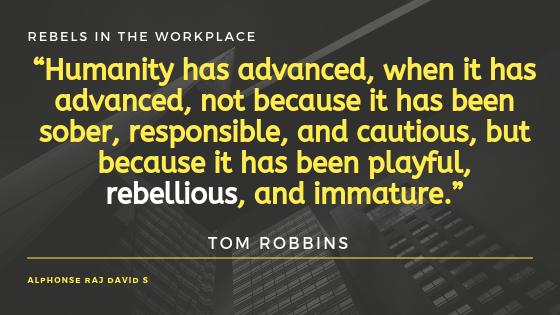
All throughout human history, it is the rebellions that have created a new and a better world and in most cases, have shaped the world as we know it. Why should the corporate world be any different?
It has always been the rebels who have actually brought about change in business and society. Heck, the tagline for the largest company in the world for a time was “Think Different” encouraging people to question the status quo.
Before we delve into my learnings and observations on rebels in the workplace. Let me explain to you my definition of a rebel:
A rebel in the workplace is a highly skilled resource who has a history of providing exceptional results both in an individual capacity and leadership role but is currently questioning the status quo
With that said, these are my learnings and observations on the do’s, don’ts, and behaviors of a successful rebel who brings about lasting change is as follows:
1. Know why you are rebelling
You are a rebel of ideas; you are rebelling because there is something whether a person or a process which is impeding you from achieving your vision. You are not against anyone. Your goal is your only focus. You happen to be called a rebel because you are trying to push the impediment to your vision. So before you start rebelling understand why is that you are rebelling. Because otherwise, you will just make a lot of enemies and not achieve anything.
2. Micro speed; Macro Patience
This is one of my favorite Gary Vee quotes. The truth about being a rebel is that more than achieving your deliverables, most of your time is spent on change management internally within the organization. This means you have to move fast in completing your tactical and operational activities. This is because in the normal course of time if you work within the system you just have to finish your deliverables. But in the case of being a rebel, you also have to do change management. So double the work with much lesser time than you will usually get as a conformist.
Also, trust the process; because changing people and making sure results are seen at a strategic level takes time. This means you have to be patient to see results. A true rebel is one who is a person of fast action but also has the patience to wait and see results happening in the longer term.
3. A Rebel needs a mentor to protect and guide
A Rebel is going to make enemies. Most rebels are so focused on their vision; that they forget the civil behavior which is essential so that they don’t make unnecessarily ruffle too many feathers. I have seen this to be true especially in the younger rebels.
This is where the mentors come into place. A mentor not only protects you but also guides you on how to navigate the workplace, and get the results you want.
4. Being a rebel gets you noticed, but conforming is what get’s you move up the ladder
Be careful, when you rebel. Make sure you don’t achieve a pyrrhic victory. Achieving your vision after stepping on everyone’s feet and antagonizing all around is not a sustainable win;
In the corporate scenario, this means even though you will have provided enormous value to the firm, but because of your rebellious attitude, it might not always translate to a promotion. You might have stepped on the foot a higher up during your period of rebelliousness.
This means you have to be prepared to wait longer to move up the ladder.
5. Temper ideas with deliverables
As a rebel, because you are the conduit of new ideas, it is easy to get carried away with talk. In order to make your dream a reality, a rebel should temper their idea creation with extreme execution skills.
A rebel is useless without execution capability. Imagine George Washington without an ability to raise and lead an army. That’s who a rebel will be without execution capability.
6. First, do what is asked; then provide more
In the beginning, no one will believe you and you will be expected to follow the beaten path. The only way for a rebel to get their way is by doing double the work at least in the beginning.
For example, the firm has been creating a pitch deck a certain way for many years and the entire sales team and management is comfortable with the same you can’t go in and just shove your new and improved sales template down their throat. In the beginning, you have to do double the work. You need to build the Pitch deck both in the old and new format and showcase how the new one is an improvement on the old one.
7. Being a rebel first and foremost is a quest for relevance
A rebel embarks on this quest of change because at the core he/she wants to be a part of something, belong somewhere and the current situation isn’t conducive for that quest.
Being relevant is something all of us aspire to be. A rebel instead of fitting in takes the route of changing the surroundings to fit him. This change is manifested in most cases in improved outcomes around him/her.
8. A rebel’s success comes with integration not raging against the system
Questioning the system on a periodic basis is necessary. But raging against the system isn’t. The most important point here is, as a rebel, you can never go to the point of no return. Disagreements are going to be a part and parcel of your day-to-day and it is easy to get carried away. Always make sure that there is room for a return to normalcy in your disagreements. Otherwise, you are just burning bridges without a chance for the creation of a tangible outcome.
9. A rebel must have his base of supporters
We all need our supporters. For a rebel to truly bring about lasting change in the system he/she must engage with the system and have along with him a team of supporters who will stand with them in achieving the goal. The most successful rebels are those who have taken their idea and built around them that core set of supporters who helped them achieve the goal.
10. Know when to stop. Understand when you have arrived and then stop talking
It’s easy to take things to the max. You have tried bringing about change and you have reached the critical mass where your thought process is now in the majority. Now is not the time for gloating nor is it the time for going on at that same aggressive pace. Become calm and most importantly stop shouting and start listening because the next step after the rebellion is reconciliation so focus your efforts on that.
All the above Learnings and Observations are with the assumption that the Rebel who is working to bring about change, is working for something better than the status quo. Or to put in more Enterprise Level language:
The rebel is working towards bringing change which will increase the value of the enterprise for all stakeholders involved
So what of the negative connotation? The rebel can also play the system for his/her personal growth at the expense of the firm. But then. in today’s world having rebels question the system is actually a good thing as it keeps the leaders on their toes and pushes innovative thinking.
That’s where the key checks and balances and most importantly the culture of the company comes into play. A firm with a highly competitive environment might give rise to rebels, who over time, carve out their own divisions and guard them like fiefdoms. The only way around it is the creation of an open culture that fosters the inclusion of new ideas whilst having the governance in place to weed out hostile ones. I am still in the process of trying to understand what steps are required to build an innovative enterprise. Maybe it could be a topic of a future post of mine.
In the end, it doesn’t matter if you are a rebel or a conformist who works within the system, as long as you bring in exceptional value, you will always be relevant.
Discover more from All my Earthly thoughts
Subscribe to get the latest posts sent to your email.
 All my Earthly thoughts